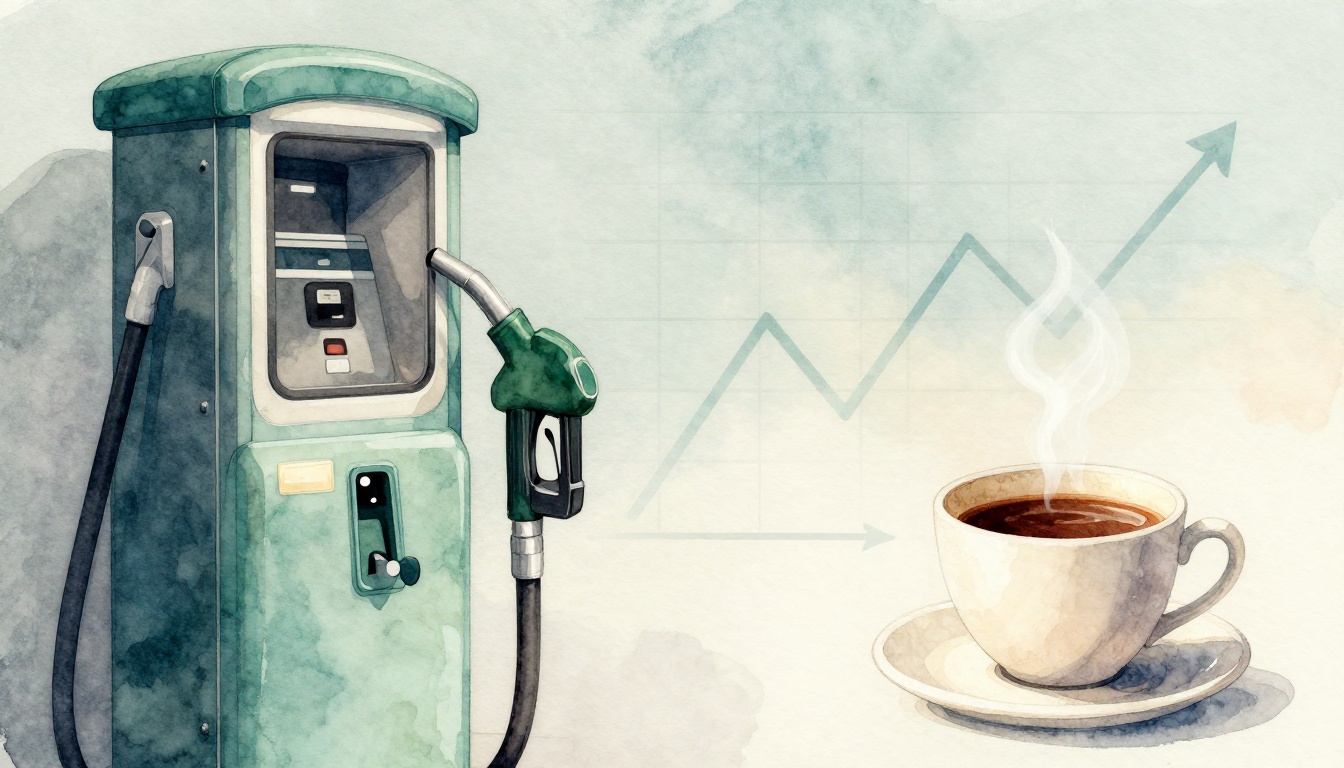
Gas prices jump every summer, and your favorite coffee rarely costs the same thing twice in a year. That’s pricing at work. Pricing is the process businesses use to set prices for products and services based on supply and demand. The market price is the point where buyers and sellers agree.
When prices move, you feel it fast. Higher costs can cut your buying, while lower prices can pull more customers in. For companies, price changes hit profits and competition at the same time, and that ripples through the broader economy.
Right now, the U.S. average gas price sits around $3.93 to $3.98 per gallon in late March 2026, and it’s rising with spring travel demand plus higher crude oil tied to Middle East conflict. Businesses often follow those cost swings when setting pump prices.
In the next sections, you’ll get the basics of pricing, why it matters so much, key pricing strategies, real-world examples, and fresh pricing trends as of March 2026.
How Supply and Demand Set the Rules for Pricing
You can think of pricing like a living thermostat. Supply tells you how much stuff exists in the world right now, and demand tells you how badly people want it. When those two forces meet, the market price lands at a spot that feels “fair” to both sides.
A simple way to picture it is with a meeting point. On one side, supply pushes prices upward when it’s tight. On the other, demand pulls prices downward when people lose interest. Where they intersect, prices tend to stabilize.

Here’s the key point: market prices are not fixed. They move because the balance between supply and demand moves. Even tiny changes can shift what buyers and sellers agree on.
For example, if a store suddenly runs out of a popular item, supply gets smaller. Buyers still want it, so sellers can charge more. If supply grows faster than demand, prices fall because sellers need buyers to clear inventory.
In addition, economic “signals” often show up as price changes. High prices usually mean demand is strong, supply is tight, or both. Low prices often mean supply is plentiful, demand is soft, or both. Businesses watch those signals closely because they guide decisions on inventory, hiring, and new product plans.
In short, pricing is the market’s way of reporting reality back to everyone. It’s a daily feedback loop, not a one-time decision.
Spotting Market Price in Action Every Day
You do not need an economics class to see supply and demand at work. Prices form all around you, in places where people trade money for goods and services every day.
Start with stock trades. A fast-moving market shows how quickly price can change when buyers and sellers react to new information. A headline about earnings, a shift in interest rates, or a sudden risk can move prices in minutes.
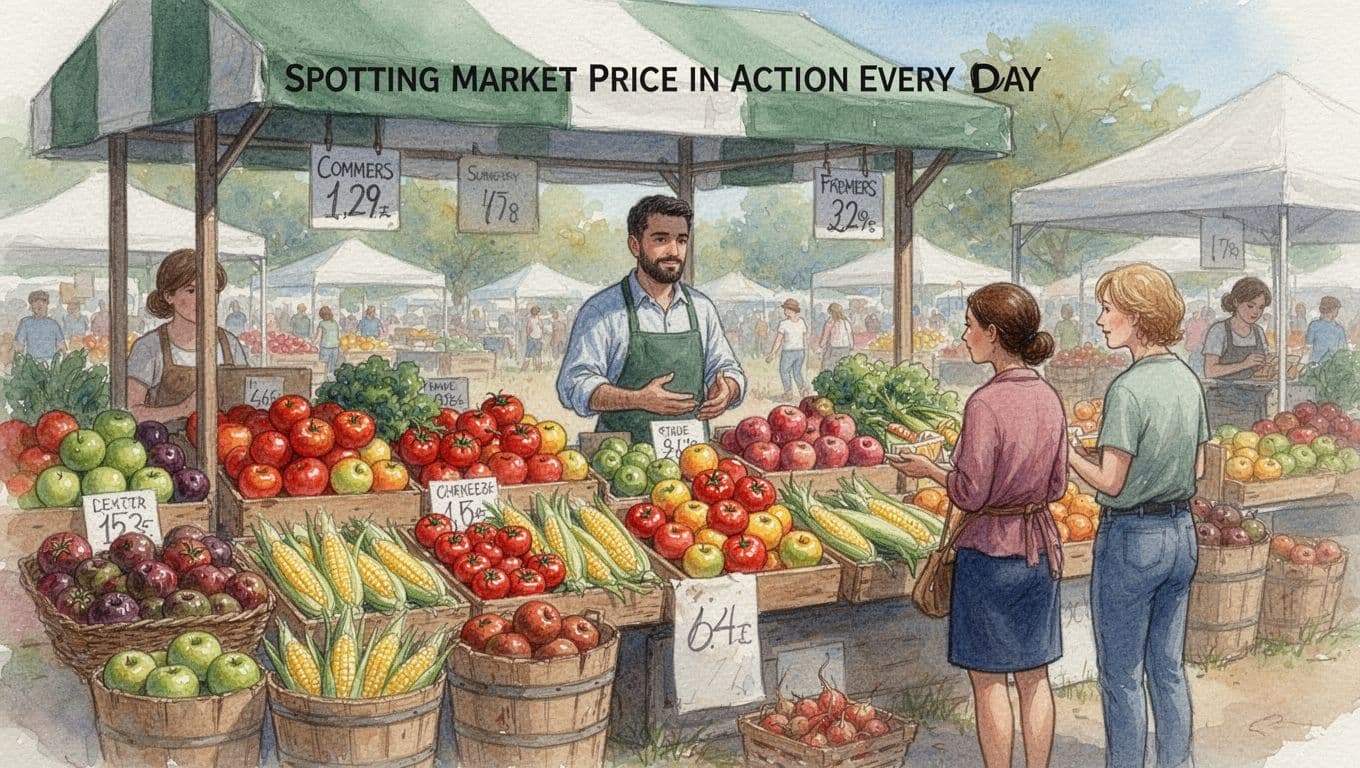
Then look at farmer markets. When a crop ripens early, supply rises. When weather wipes out part of a harvest, supply drops. Either way, the price tag often changes during the season, not on some fixed schedule.
You can also spot it in everyday purchases, like:
- Concert tickets: When demand spikes, prices rise. If fewer people buy, prices soften.
- Airline tickets: Higher travel demand pushes prices up. Extra seats or low demand pulls them down.
- Coffee shops: A limited menu or short-staffed day can reduce supply. Lines and wait times often reflect demand.
- ICE cream on hot days: Demand climbs fast. More trucks might show up, which increases supply and can calm price.
What’s happening behind the scenes is simple. Supply and demand change, then buyers and sellers adjust. As conditions shift, the “sweet spot” price shifts too.
Small events matter because they change the next buyer’s choice. When you notice prices moving day to day, you are watching the market do its job.
Why Getting Pricing Right Fuels Business Wins and Market Growth
Pricing does more than tag a number to a product. It decides who you win, how fast you grow, and how steady your revenue feels across seasons. When your prices fit customer value and real costs, you stop bleeding margin and start pulling demand.
Think of pricing like a set of brakes and a steering wheel in one. Move it the wrong way, and growth turns shaky. Set it right, and your business moves forward with control.
Staying Ahead of Competitors Through Smart Pricing
Smart pricing keeps you competitive because it helps you react faster than rivals. When customers compare options, they feel differences immediately. If you price too high, shoppers drift. If you price too low without a plan, you lose money and still fall behind.
In a price war, companies often chase the same headline number. One big retailer cuts prices to win traffic. Then the next one follows, and margins shrink across the aisle. For example, Target has announced broader price reductions across thousands of products to rebuild sales momentum, betting that value-focused shoppers will return. You can read coverage of that approach in Target’s price cuts and merchandising shift.
Meanwhile, the grocery world shows how quickly this pressure can return. When households feel budgets tighten, retailers compete harder on value, and the cycle repeats. That dynamic has been highlighted in supermarket price war pressure.
Here’s the key difference smart companies make: they do not treat every product the same. Instead, they protect the items that drive trust and volume, while adjusting less visible items to preserve profit.
How price wars happen, and how you can respond better
Price wars often start with a small spark. A competitor runs a promotion, a supplier cost changes, or demand swings with the weather. Then, customers ask, “Why should I pay more?”
You can respond with more than a single discount. For example, you might:
- Lower prices on “traffic drivers” to pull customers in.
- Keep higher margin on “brand favorites” when demand is still strong.
- Adjust bundles so the customer sees a better deal, even if unit pricing stays steadier.
In practice, that means you fight for attention on the products people talk about, not every SKU.
Using dynamic pricing to stay in the race
Many retailers now use dynamic pricing, which updates prices as conditions change. That matters because competitors often do it too, so “set it once” pricing becomes a slow strategy. Recent reporting notes that large players, including Walmart and Kroger, use dynamic pricing and that many price changes include both increases and decreases. For a closer look, see dynamic pricing in major grocery.
In other words, pricing becomes less like a fixed menu and more like a moving map. When demand rises, you can capture value. When demand drops, you can clear inventory without waiting for a quarter-end surprise.

The growth advantage: prices that match how customers decide
When pricing is correct, you win in two ways at once. First, you attract new buyers who feel the value. Second, you keep existing buyers because the price feels fair compared to alternatives.
Also, good pricing sends strong market signals. If shoppers keep buying at a certain price, it tells you to plan more production. If they stop, it tells you to adjust before inventory becomes a costly pileup.
For a practical example, coverage on dynamic pricing trends also points out which retailers frequently adjust prices, including Walmart among top dynamic pricing adjusters. The takeaway is simple: when competitors change prices often, you must measure and respond with the same speed, or customers will drift to the better deal.
In short, smart pricing protects margin, attracts demand, and keeps you competitive when the market shifts.
Dynamic Pricing and AI Tools Changing the Game
Dynamic pricing sounds fancy, but the idea is simple. You change prices as conditions change, instead of setting one “forever” number. That approach shows up in rideshares and airlines all the time, because demand and supply swing minute to minute.
In March 2026, the big shift for small businesses is AI-driven pricing that can adjust faster and more safely. Instead of guessing, you can monitor stock, traffic, customer actions, and competitor moves, then reprice with guardrails. If you want pricing that keeps up with real markets, this is where it’s headed.

Rideshares and airlines: the real-world proof
When Uber-like rides surge, riders see higher fares fast. That’s surge pricing, and it exists to balance supply and demand quickly. More drivers get online when prices rise, so wait times drop. Once demand cools, prices fall again.
Airlines run a similar model, just with more moving parts. Ticket prices change based on bookings, seats left, booking time, seasonality, and even weather. Airlines use yield management to sell the right seats to the right buyers at the right time. In the U.S., riders do not see “cost-plus math,” they see a fare that moves because the market is moving.
Here’s the takeaway you can use: dynamic pricing works when three things are true.
- Demand changes fast (not once a quarter)
- Supply can’t instantly expand (a car or seat is limited)
- Customers still compare options (people notice price differences)
So if your market has fast shifts and limited capacity, dynamic pricing is not just a trend. It’s a practical fit.
What AI adds in 2026 for small businesses
AI turns dynamic pricing from a big-company habit into something smaller brands can run. In today’s tools, the system can update prices often using real-time inputs like inventory levels, traffic patterns, and purchase behavior. As a result, you get fewer dead price guesses and more targeted moves.
Also, AI lets you go beyond “up or down.” You can create hybrid approaches, like a mostly stable base price with controlled adjustments around peak demand. That matters because customers often hate sudden chaos. If you change too aggressively, you risk refunds, support tickets, or lost trust.
A smart starting point is to think in value, not just math. For example, if people pay more during bad weather, AI can raise prices for umbrellas without spiking unrelated items. That keeps your pricing aligned with the story your customers already believe.
For a real, small-business perspective on why this can help, see AI-Supported Pricing Is Helping Small Businesses Compete.
The best dynamic pricing feels consistent to customers, even if it changes behind the scenes.
How competitor scanning works (without starting a price war)
In 2026, competitor monitoring is a major driver of AI pricing. Tools can scan or track competitor prices, then suggest adjustments so you stay competitive. That helps you avoid a common trap: cutting prices because you fear losing customers, then realizing you could have held margin.
However, there’s a big difference between staying competitive and entering a race. Price wars happen when everyone reacts to the same signals with the same timing. AI can help you react faster, but you still need a plan.
A practical way to avoid chaos is to set rules that reflect your strategy:
- Use guardrails: cap how much prices can move in a day.
- Prioritize margin on core items: let value props stay strong.
- Discount only when it earns attention: promotions should have a reason, not just reflex.
Also, watch how competitors price categories. Sometimes rivals discount the items that pull shoppers in. In response, you might keep those items steady and adjust bundles, subscriptions, or add-ons instead.
If you want tool examples for a “compare before you buy” approach, browse AI Pricing Tool Comparison for 2026.

A simple way to deploy dynamic pricing safely
You do not need a massive rollout. You need a clean test, clear limits, and measurable results. Start where prices already move, or where demand shifts quickly.
A safe rollout usually looks like this:
- Pick one category where customers compare quickly (not your whole catalog).
- Run small experiments, like changing price bands rather than random numbers.
- Track conversion rate and profit, not just sales volume.
- Add a “trust line” customers can understand, like “pricing updates during high demand hours.”
In other words, treat dynamic pricing like a thermostat test, not like a demolition project. You’re tuning comfort, not rewriting your business overnight.
Finally, remember that some states have rules around how dynamic pricing can be applied, especially in ways that feel deceptive. If you use AI, keep it transparent in your own customer experience, and avoid surprise pricing logic.
When you get it right, dynamic pricing turns your store into a living market. You respond with speed, but you stay in control with boundaries.
Pricing Stories from Netflix to Gas Pumps
Dynamic pricing sounds logical when it’s explained with math. In real life, it feels personal. People don’t just pay a price, they judge the story behind it. That’s why pricing backlash keeps repeating across industries, from streaming to tickets to gas stations.
The pattern is steady: companies test pricing that reacts to demand, then customers feel the change arrives “too fast” or “for the wrong reason.” When trust dips, even fair pricing starts to look like a trick. The best firms learn to slow down, clarify, and adapt the moment the public pushes back.
Lessons from Surge Pricing Backlash
Surge pricing is the clearest example of how quickly good pricing logic can turn into bad customer emotion. In entertainment and live events, prices often rise when attendance spikes. However, the backlash usually comes from how the final price shows up, not only from the final number.
Take the live-event fee controversy. In 2025, the FTC pushed a nationwide rule on unfair or deceptive fees for ticketing, requiring a clear, upfront “total price” rather than a low base price plus surprise add-ons later in checkout. The FTC rule took effect in May 2025, and it aimed at what people call “drip pricing” (when fees appear after you commit). You can see the FTC’s details in the FTC rule on unfair or deceptive fees.
Now compare that with how customers react to Netflix. When Netflix raised prices across its streaming plans in 2026, subscribers didn’t argue about their engineering model. They reacted to the change hitting their wallets again, right when budgets already felt tight. Coverage like Netflix raises prices across all streaming plans shows how the move landed as “yet another increase,” even if the company framed it as investment in content.
So what’s the common lesson?
Customers accept higher pricing when they believe three things are true:
- The reason feels real (cost pressure, limited supply, or new value).
- The price feels honest (no hidden fees, no last-second surprises).
- The change feels fair (not random, not targeted, not constant).
Gas stations teach the same lesson in plain language. When supply shocks hit, prices climb quickly. Yet people usually don’t blame the pump itself, they blame the broader crisis, especially if prices rise in a way that matches news they already heard. If a station suddenly jumps without explanation, customers assume the motive is profit, not cost.
Companies also adapt their tactics once backlash starts. Some do it by adjusting how prices are shown. Others do it by changing when they move prices. Many shift from aggressive, frequent re-pricing to more predictable pricing windows, because predictability protects trust.
Finally, watch the 2026 angle that ties pricing stories together: shoppers still want “green,” but they also want the premium to feel earned. In March 2026, many Americans report willingness to pay more for green products, about 9.7% more on average, but only when brands show proof and keep prices reasonable. That means the best pricing lessons from Netflix, gas pumps, and surge events point to one outcome: pricing must match the story customers think they’re buying.
Pricing Trends to Watch in 2026 and Beyond
Pricing in 2026 is changing for a simple reason. Customers feel the cost of everything, and they also watch for fairness. So businesses are shifting from one-size pricing to blended, faster, and more explainable moves.
Meanwhile, inflation is cooling, but it’s not gone. That means many firms can raise prices more calmly, instead of doing big, scary jumps. Also, online shopping keeps surging, so e-commerce pricing now moves like traffic on a busy highway.

Cooled inflation pushes steady, blended price strategies
Inflation may be less hot than before, but costs still matter. In late 2026, many firms see inflation around the low 3% range, which changes how they price day to day. Instead of one big increase, you often see smaller price moves that happen more often.
That creates a blended approach. Companies blend tactics, like:
- Price resets on core items, not the whole catalog.
- Smaller promo windows, so deals feel earned, not constant.
- Tiered value, where customers choose the speed or level of service they want.
Think of it like cooking. You still add salt, but you add it gradually. Customers trust you more when the flavor changes gently.
Also, inflation pressure shows up unevenly. Healthcare costs can rise faster than general inflation, and that affects service pricing more than products. So pricing gets more specific. You see more “pay for what you get” options, especially in services and subscriptions.
AI real-time adjustments, with guardrails after customer pushback
AI-driven pricing is rising fast in 2026. It can adjust prices in real time based on demand, costs, inventory, and competitor moves. That sounds powerful, and it is. However, the real trick is using AI in a way customers can accept.
After years of backlash against surprise fees, drip pricing, and confusing checkout math, brands can’t treat re-pricing like a hidden switch. Many teams now add guardrails. They cap how fast prices change, and they decide where AI can or can’t touch pricing.
In practice, this often becomes a post-backlash mindset:
Customers tolerate price changes, but they do not tolerate mystery.
So teams focus on transparency. They also focus on consistency, especially during peak demand. If you change prices too often, people feel like you moved the goalposts.
If you want an example angle on how merchants plan AI pricing for e-commerce, this guide on an AI dynamic pricing playbook is a useful reference point: AI dynamic pricing in 2026 e-commerce.
Eco-friendly premium pricing keeps expanding, but it must be proven
Eco-friendly pricing is not just a marketing label anymore. In 2026, many businesses charge more for “green” options because customers want that value. Still, the premium works only when the brand backs it up.
That means you should expect evidence-based premiums. Customers want proof that the extra cost buys something real, like lower emissions, better materials, or smarter packaging. If you can’t show the reason, the premium feels like a tax.
A smart eco strategy often looks like this:
- Clean tiers (good, better, best) so customers can choose.
- Clear trade-offs, like paying more for slower shipping or lighter packaging.
- Service add-ons, where sustainability ties to outcomes, not slogans.
Also, eco pricing tends to spread through bundles. People buy one item, then they add the “right” option because it feels aligned with their values. That’s why many companies pair sustainability with the core product, not with a random add-on.
E-commerce surges drive pricing that changes faster online
Online shopping keeps growing, and pricing reacts to that reality. E-commerce is sensitive to speed and inventory, so prices often change when stock tightens or tariffs raise import costs. Some firms pass along extra import costs for certain categories, especially when supply gets thin.
As a result, shoppers see a new pattern. Prices can jump, then settle, then jump again. That cycle feels normal online, but it still needs an explanation. Otherwise, customers assume the worst.
To reduce backlash, many teams improve the “why” around price changes. They might use clearer shipping timelines, tighter product availability rules, or better checkout totals. Even better, some brands keep a steady base price and make changes mainly through bundles.
If you’re building an e-commerce pricing plan for 2026, it helps to study how inventory-linked AI pricing models work. Here’s one strategy write-up to consider: inventory-linked AI dynamic pricing.
How to adapt to 2026 pricing trends without losing trust
Trends are exciting, but your job is to keep customers on your side. So adapt in a way that protects value and clarity. You can do that with practical steps that fit most businesses.
Start with how you’ll make price changes. Then set rules for when you’ll change them. Finally, decide what you’ll say to customers when prices move.
A good adaptation plan usually includes:
- Pick the zones you’ll test (one product line or one region).
- Use pricing guardrails (caps on daily or weekly changes).
- Track profit and trust signals, not sales alone.
- Explain the reason, especially during sudden shifts.
- Match competitor speed only where it matters (core items, not everything).
For eco pricing, also add a proof step. Don’t just price “green,” document it and show it. For AI pricing, don’t let the model surprise your buyers. Instead, let the system act within limits you designed.
In other words, 2026 pricing rewards teams that move quickly and speak clearly.
Conclusion
Pricing is how markets balance reality, supply, and demand into one number people can act on. When you understand that process, you see why prices shift, why customers react, and why profits rise or fall as a result.
The strongest takeaway is this: good pricing protects trust while still matching real costs and demand. That’s why businesses use smarter tactics like dynamic pricing, and why they must show the “why” behind changes when buyers feel squeezed.
If you want to apply this today, watch how prices move in your day-to-day life, gas, tickets, or online checkout totals. Then test one small pricing or packaging change, track profit and customer feedback, and adjust fast where you learn. What price pattern do you notice most, and what reason do you think drives it?